
Europe likes to tell a story about progress.
A story in which clean mobility, industrial strength, and climate responsibility move forward together. With the publication of its new Automotive Package, the European Commission once again positions itself as the architect of this future. The message is familiar: climate neutrality by 2050, regulatory simplification, and renewed competitiveness for Europe’s automotive sector.
At first glance, the narrative feels reassuring.
But when we look closer at what is included, and at what is missing, a different picture emerges.
When “small” stops meaning small
One of the central elements of the package is the proposed Small and Affordable Electric Cars Initiative, including so-called super-credits for compact electric vehicles built in Europe. The goal is to accelerate access to zero-emission mobility and strengthen European production. Yet under the Commission’s proposal, a vehicle such as the Jeep Avenger Electric, more than four metres long and weighing over 1.5 tonnes, qualifies as a “small car”.
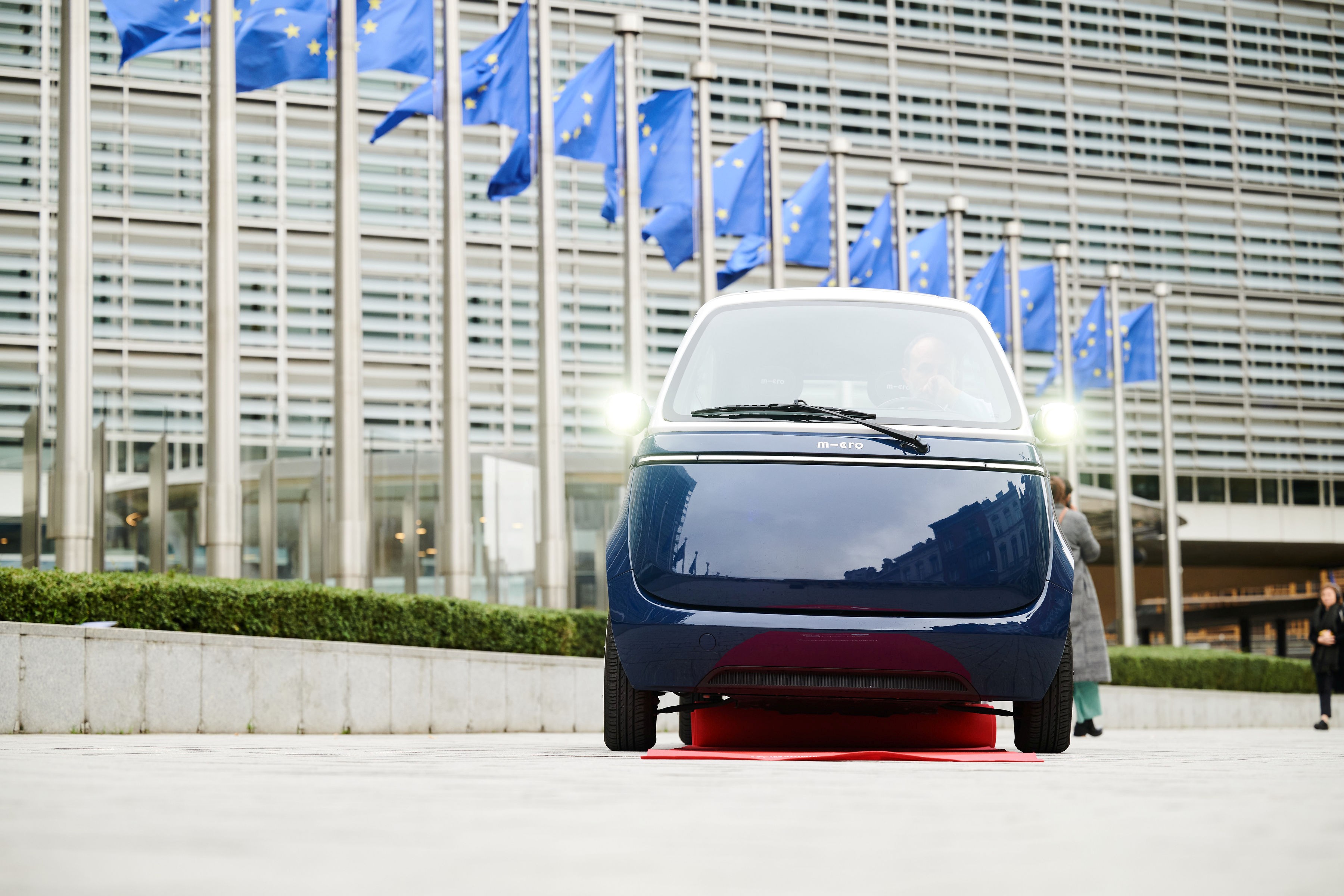
By contrast, vehicles that are genuinely small, lightweight, and optimised for urban mobility, such as the Microlino or the Silence S04, are entirely absent from the framework.
This contradiction is difficult to ignore. The vehicles that consume the least energy, use the fewest materials, and occupy the least space receive no recognition within a policy that claims to promote efficiency and sustainability.
A strategic dialogue without results
This omission is not due to a lack of input from the light electric vehicle sector.
Earlier this year, LEVA-EU was invited by Commissioners Wopke Hoekstra and Jessika Roswall to contribute to the Strategic Dialogue on the Future of the European Automotive Industry, launched under the leadership of Commission President Ursula von der Leyen.
LEVA-EU submitted concrete proposals aimed at unlocking the full potential of light electric vehicles across Europe. None of these proposals are reflected in the final Automotive Package.
This raises serious questions about the credibility of the process. A dialogue that invites participation but produces outcomes that reinforce existing structures risks becoming an exercise in appearance rather than substance.
The real cost of ignoring light electric vehicles
Light electric vehicles already exist. They are already manufactured in Europe. They already serve real mobility needs, particularly in urban and peri-urban environments.
They are cheaper to produce and purchase than conventional cars, require far fewer resources, and are ideally suited for short daily trips. They reduce congestion, lower energy demand, and free up valuable urban space.
Despite this, L-category vehicles remain subject to largely unadapted technical legislation and are excluded from most financial and fiscal incentive schemes. As a result, heavier and more resource-intensive vehicles benefit from public support, while truly efficient solutions are sidelined.
A question of coherence and credibility
The Commission emphasises that the Automotive Package respects technological neutrality. Yet neutrality cannot mean systematically favouring one vehicle category while ignoring others that clearly outperform it on efficiency and sustainability.
A credible Small Cars Initiative must include genuinely small vehicles. This means recognising microcars and other light electric vehicles as part of Europe’s mobility solution, adapting legislation accordingly, and aligning incentives with real-world efficiency rather than vehicle size in name only.
The Microcar Coalition, together with LEVA-EU and its members, will continue to engage constructively with European institutions. Europe does not lack innovation. What is missing is a policy framework that fully acknowledges it.
The smallest vehicles may not dominate the headlines, but they could play a decisive role in shaping a truly sustainable mobility future.
Read the press release:
https://www.yumpu.com/s/qL7PhD62ZXSFwyTK
